How Beliefs Are Formed: Who Taught You What to Believe?
We like to believe our convictions are our own.
What am I talking about?
Take, for instance:
- Our views on success
- Our opinions about politics
- Our sense of right and wrong
- Parts of our identity
We carry these beliefs and convictions around with us as if we authored them. And for some of our beliefs and personal philosophies, that would be correct. However, pick one or two beliefs and take this quick audit by asking yourself four questions:
Ask Yourself These Four Questions About Your Beliefs
- Where did this belief come from?
- Who might have been the first to model it for me?
- Who might have repeated this belief to me over and over?
- What system or entity besides myself benefits from me holding onto this belief?
If you’re honest, most of what you believe didn’t originate with you.
It was imprinted upon you.
In some cases, installed.
Please don’t panic if this realization makes you feel uncomfortable. This is part of being human.
Beliefs Were Shaped Before You Could Choose

From the moment you were born, you were immersed in influences from what I call the “big six”:
- Family
- Religion
- Education
- Culture
- Government
- Media
Did these systems ask for your consent? Did they wait for your critical thinking skills to mature before imposing beliefs and philosophies upon you? Or did they teach, model, reward, and reinforce what they expected you to adapt to and adopt as your own? Psychology calls this socialization.
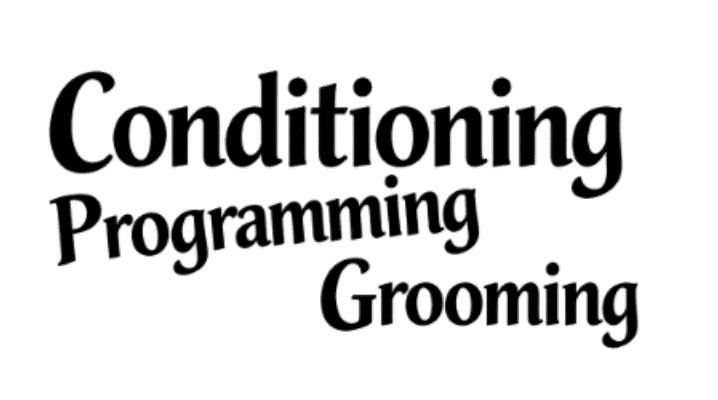
In more uncomfortable language, I might describe what happened to me, and likely what happened to you, using these words:
- Conditioning
- Programming
- Grooming
For me, those words feel more honest and current. To be fair, I also want to acknowledge that not all early influence is harmful. I have a strong conviction toward integrity that I believe I was born with, and my family reinforced and modeled that well. Over time, however, my own definition of integrity departed from my family’s definition and evolved into something deeply personal.
Their definition included showing unconditional fealty to religion. Mine extracted itself free and clear from any formal religious system. For me, integrity means aligning as many of my actions as possible with my core values. My core values tell me whether I’m living aligned with my personal code of integrity. No outside source dictates that to me.
The Invisible Architecture of Belief
Human beings are social learners.
We learn through:
- Imitation
- Belonging
- Trust
What most of us fail to acknowledge is that these same social structures that teach us how to love, cooperate, and succeed are also the very mechanisms that can quietly shape what we believe. And this often happens without our awareness.
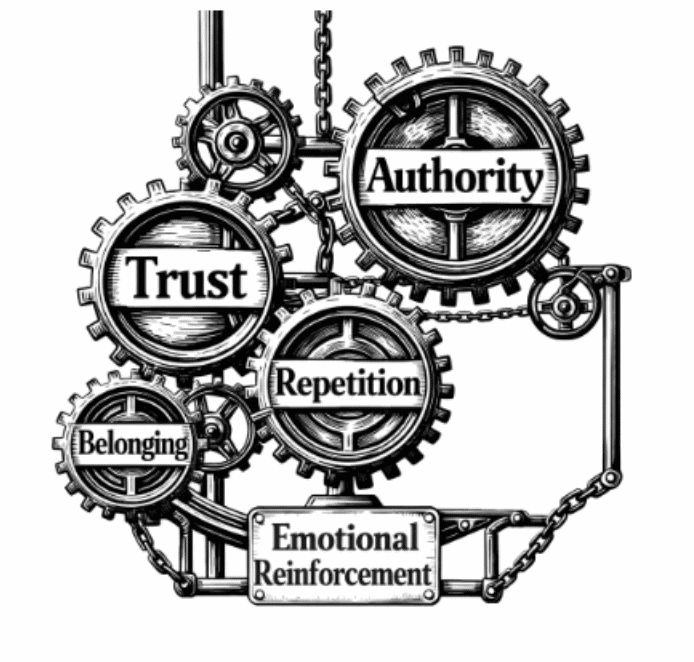
While these elements are part of healthy development, they can also become tools of:
- Persuasion
- Propaganda
- Control
And what I find equally interesting, and perhaps a bit alarming, is that you and I don’t just hold beliefs from our childhood years. Sometimes our beliefs are holding us.
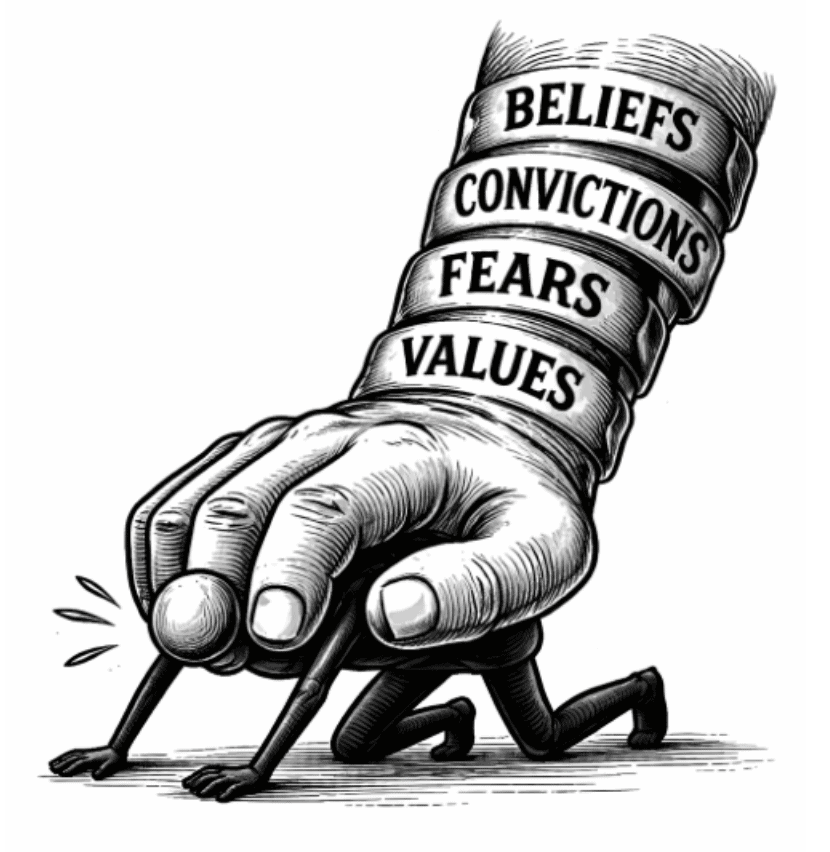
Why Belief Systems Feel Like Truth
Research shows we are deeply influenced by:
- What authority figures say
- What the group accepts
- What is repeated frequently
- What triggers emotion such as fear, pride, and belonging
In today’s world, those forces are amplified by algorithms, media, and constant exposure. This means that over time, what feels familiar can become our truth. What we hear repeatedly can begin to feel like certainty. And when we don’t examine our beliefs, belonging to certain groups can quietly become agreement.
Before long, we may find ourselves defending ideas we never consciously chose.
Are Your Beliefs Actually Yours?
That question matters more than most people realize.
Do these beliefs belong to me?
Or were they inherited?
Installed?
Rewarded?
Conditioned?
And if they no longer feel true for you, are you willing to let them go?
Part Two: How Beliefs Become Embedded in the Nervous System
I’m going to stop here and let these ideas simmer on the back burner of your mind.
In my next Guidepost, I’m diving deeper into this concept because what we’re talking about isn’t purely philosophical. It’s biological. It involves neurochemicals.
Our beliefs are not abstract ideas floating around in our minds. They become embedded in the nervous system. And that’s one reason changing them can feel so difficult.
If You Want Support Exploring This Further
If this article sparked questions about your own beliefs, identity, relationships, or personal sovereignty, here are a few ways you can continue exploring.
Book a 20-Minute Discovery Call
If you’re ready to examine the beliefs shaping your life, relationships, identity, or decisions, fill out my intake form and let’s connect for a 20-minute conversation. Fill out our coaching intake form here to get started.
Read the Related Blog
My life partner has written a complementary piece that explores similar themes from another perspective. If you’d like to go deeper, you can read that article here.
Read My Book
If you prefer to explore these ideas privately and at your own pace, my book dives deeper into belief systems, identity, and self-authorship. I recommend starting with Chapter 3 and Chapter 6. Buy it here.
Watch My TEDx Talk
This talk may help you begin listening more closely to your own inner wisdom, your heart, your instincts, and your inner knowing instead of constantly taking cues from external systems. Watch it here.
Explore the Research
If you enjoy diving into the psychology and research behind these ideas, review the bibliography below and choose one resource that feels relevant to you right now.
Bibliography
Bandura, A. Social Learning Theory — How we learn behavior and beliefs through observation.
Asch, S. E. Studies of Conformity — How group pressure shapes belief and behavior.
Milgram, S. Obedience to Authority — Why people follow authority, even against their judgment.
Deutsch, M., & Gerard, H. Social Influence Research — Normative (belonging) and informational (trusting others) influence.
Cialdini, R. Influence: The Psychology of Persuasion — The science behind persuasion, repetition, and authority.
Craven, S., Brown, S., & Gilchrist, E. Sexual Grooming of Children — Research on grooming dynamics and influence patterns.
Lifton, R. J. Thought Reform and the Psychology of Totalism — How belief systems are shaped in high-control environments.
Lewandowsky, S., Ecker, U., & Cook, J. The Post-Truth Era — How repetition and misinformation shape belief.
Fanon, F. Black Skin, White Masks — The psychological impact of cultural and colonial influence.
Said, E. Orientalism — How systems shape identity and worldview.
Ngũgĩ wa Thiong’o. Decolonising the Mind — Language and culture as tools of belief formation.
Lipton, B. The Biology of Belief — How beliefs influence biology and subconscious programming.
Kegan, R. The Evolving Self; In Over Our Heads — Adult development and the shift to self-authorship.
Kegan, R., & Lahey, L. Immunity to Change — Why we resist changing even when we want to.