
A Few Good People
There are times in life when going at it alone is overrated. Yes, INDEPENDENCE matters. Indeed, Self-Trust matters. Learning to listen to your own inner wisdom matters enormously. I’m all about each of us expressing as much of all three, as much of the time, as is possible.
With that said, none of these require that we keep ourselves in isolation. We all need connection.
The strongest, wisest, most resilient people I know have the three elements mentioned above within their behaviors. Something else is working in their favor as well: a small circle of good humans they trust.
I call this a personal support team.
What Is a Personal Support Team?
A personal support team is a small circle of people you trust for encouragement, honest perspective, and support through life’s challenges and successes.
And to be clear, a support team is not:
- Having an audience.
- Having an entourage.
- Having 300 to 3,000 social-media friends.
I’m talking about having a few good people standing next to you and in your corner who are good at cheering you on and supporting you.
In fact, I was working with a client last week, encouraging him to stop going at it alone. We started by adding one or two good-hearted and competent souls to his sideline.
What we’re looking for when we create a support team is a small group of people who can sit beside you when things get hard, celebrate when things go right, challenge you when you’re fooling yourself, ask you hard questions, and remind you who you are when life temporarily knocks the shit out of you.

Some might even start to call this support a personal TRUST team.
Trust Is the Price of Admission
Years ago, I wrote about building trust within teams and shared Judith E. Glaser’s TRUST model:
Transparency. Respect. Understanding. Shared Success. Tell the Truth.
Those same principles may be even more important when deciding who belongs close to us.
I say this because I’ve found, as have some of you, that proximity isn’t the same thing as trustworthiness.
Someone you have known for twenty years may not deserve access to your most vulnerable places. Another person may enter your life much later and demonstrate, through their behavior, that they’re capable of standing beside you when it counts.
Longevity of a relationship does not necessarily equal trustworthiness.
I work with a formula to determine how trustworthy a person might be. Turns out trustworthiness is a matter of combining a person’s character and their competence, as exhibited over and over again through their behaviors.
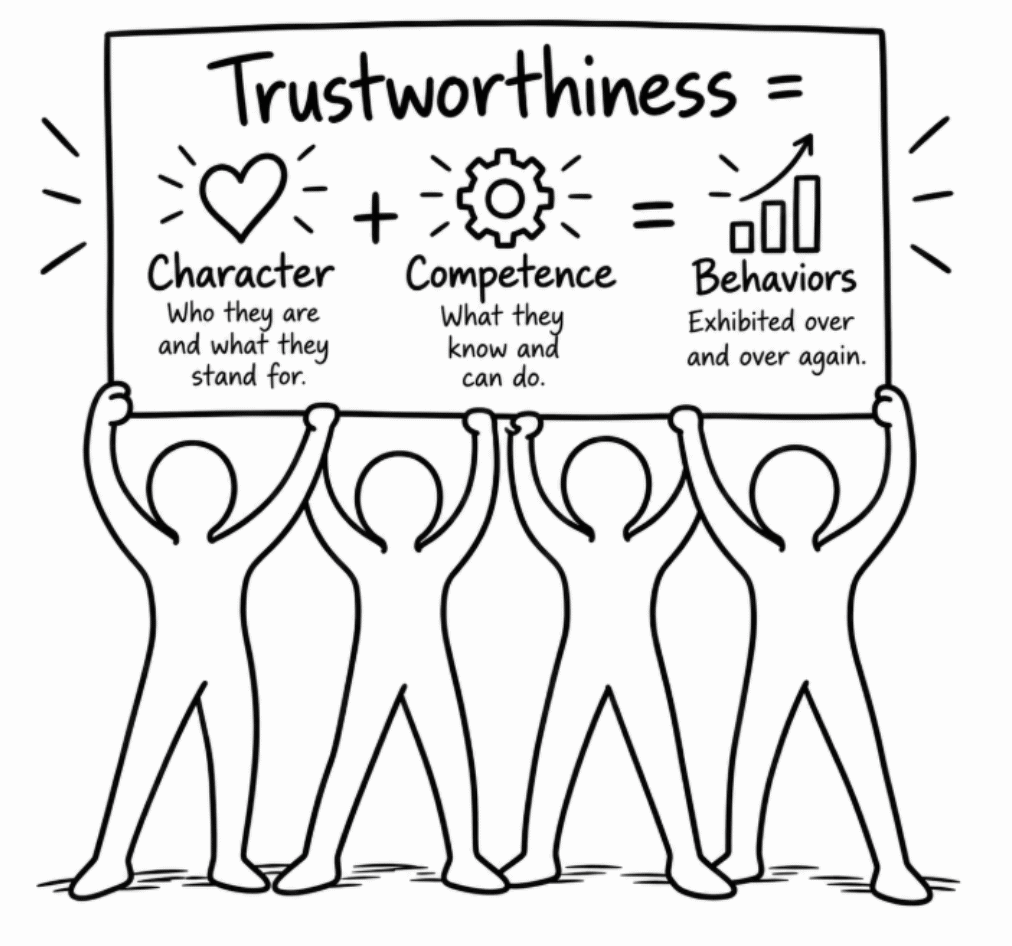
Do you have a highly trusted, extremely valued, formalized (to some degree) support team? Would you like one?
If you said “yes,” the first question I suggest you ask yourself isn’t:
Who has been around the longest?
It’s:
Who has earned a seat?
The Five TRUST Tests for Your Personal Support Team
Before putting someone on your personal support team, run the relationship through these five questions I’ve adapted from Glaser’s TRUST model.
1. Transparency: Can You Be Real With Each Other?
Can you be real with each other without performing, hiding, or constantly managing the other person’s reaction?
2. Respect: Do They Respect Your Choices and Boundaries?
Does this person respect my choices, boundaries, values, and autonomy? Even when they would choose differently?
3. Understanding: Do They Try to Understand You?
Do they “get” me? When they don’t, do they try to understand me rather than immediately fixing, judging, advising, or projecting?
4. Shared Success: Can They Celebrate Your Wins?
Can they genuinely root for me? When something wonderful happens, can they celebrate without competing, diminishing, or making it about themselves?
5. Tell the Truth: Will They Be Honest With You?
Will they lovingly tell me something I may not want to hear? Can I trust that their honesty comes from care rather than criticism or control?
Think about these five qualities. They make a damn good entrance exam.
You Don’t Want to Build a Team of Clones or Robots

Your support team doesn’t need to be made up of people who all support you in the same way.
One person may be your truth teller.
Another may be the person who can sit quietly beside you when your world falls apart.
Someone else may be the person who says, “Get up. You’ve got this.”
Another may be the person you call when you’re standing at a crossroads and need someone capable of asking a great question without telling you which road to take.
And someone needs to be able to celebrate the hell out of you when you win.
The goal isn’t to find one magical human capable of meeting every need.
Build a bench.
Do this by asking: Who is worthy of being on my team?
A trustworthy support team can’t be purchased. It is important to avoid running out and randomly acquiring one.
Check yourself and be deliberate about building your team.
Trust Works Both Ways: What Kind of Support Do You Offer?
Think about your responsibilities too.
If I expect transparency, do I need to practice it more?
If I want respect, how well do I offer it?
If I want people to understand me, am I listening to them and “getting” what they are telling me? Do I remain curious and open?
If I want people who celebrate my success, am I able to celebrate theirs? Can I celebrate my own success in a healthy manner?
And if I want people courageous enough to tell me the truth, how capable am I of hearing it? How honest am I? How often do I tell the truth?
Go ahead and noodle on this a bit.
Hopefully I’ve been able to get you started thinking about your team members.
And that’s what I’m challenging you to do right now. Start building your team.
How to Start Building Your Personal Support Team
ASK: Who are the three to five people I would intentionally go to for support? What has each of them done to earn that seat?
Be sure these are people who have earned your trust through their character, competence, and behavior. People who know when to cheer, when to listen, when to challenge you, and when to remind you who you are.
And because trust works both ways, there’s one more question worth asking:
Whose support team am I worthy of being on?
Maybe the answers to this question will give you even more ideas about who you can recruit to your bench.
You don’t need an army standing behind you. You need a few good people you deeply trust standing beside you.
What to Say When Inviting Someone Onto Your Support Team
Here are a couple of scripts you can use to invite people onto your sideline:
“I’ve been thinking about the few people I really trust and want intentionally in my corner. You’re one of them. I’m putting together a small personal support team made up of individuals I can turn to for perspective, truth, encouragement, and the occasional kick in the ass. Would you be willing to be one of those people for me?”
“I’m putting together a small group of people I know I can count on when life gets messy, when I need some perspective, or when I just need somebody solid in my corner. You’re already that kind of person for me. I’d love to officially put you on my bench. You in?”
Alright!?! Go get that team together and check in if you’d like to share some of the benefits you’ve gained from having a support team.
For more on nurturing these connections, explore the American Psychological Association’s guide to strengthening your support network.