How to Trust Yourself in Uncertain Times
When the world around you becomes less predictable, your ability to believe in yourself becomes more important.
Learning how to trust yourself in uncertain times begins with recognizing what you can bring to the moment: your experience, your judgment, your values, and your willingness to learn.
Many of the things we have counted on for stability are being questioned, challenged, and, in some cases, dismantled. Technology is changing how we work and what we believe. Social and political issues test our relationships and communities.
Perhaps you have felt it yourself.
It can be unsettling when rules and norms change faster than you can keep up. It can be disturbing when once-trusted institutions behave unexpectedly. Sometimes, the future you have been preparing for no longer resembles the one you are walking into.
So, what happens when the world you have relied upon no longer feels dependable?
I believe one of the most important answers is this: You learn to rely more deeply on yourself.

Why Uncertainty Can Make You Question Yourself
When we stop trusting the world around us, we can inadvertently begin questioning ourselves.
We second-guess our judgment. We wait for someone with greater authority to tell us what to do. We search for certainty before acting.
We may become increasingly reactive to what is happening around us, losing sight of how we want to respond.
Sometimes, without realizing it, we hand over our personal authority to the loudest voice in the room.
If you recognize yourself in this, begin with a little compassion.
You do not have to know all the answers right now. You do not need to control everything that is happening. And you do not have to navigate this alone.
You can begin by strengthening your trust in your ability to respond.
Trusting Yourself Includes Being Willing to Learn
Years ago, I wrote How to Believe in Yourself (In 5 Simple Steps). It explored how to develop confidence by building on your strengths, embracing who you are, adopting a growth mindset, and becoming more comfortable with discomfort.
I stand by those ideas.
Today, I would add another layer: Believing in yourself includes trusting your ability to question your assumptions, recognize when you are mistaken, and change direction as you learn.
You can listen to others while exercising your own judgment. You can ask for support while remaining responsible for your choices. You can feel uncertain and still take a thoughtful next step.
These five practices can help you build that kind of trust.
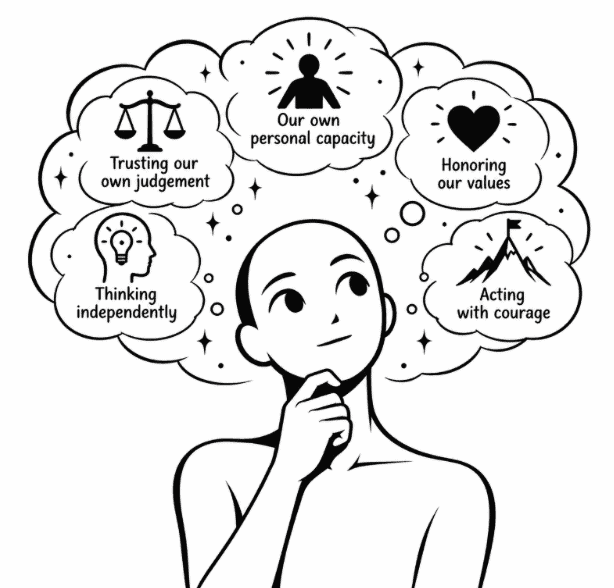
How to Trust Yourself in Uncertain Times: Five Practices
1. Recognize the Capacity You Have Already Built
Take stock of the challenges you have navigated and the strengths, skills, and wisdom you have gained along the way.
Perhaps you have managed a difficult transition, rebuilt after a disappointment, or learned to have conversations you once avoided.
Those experiences give you something to draw upon today.
Ask yourself: What have I already lived through that can help me meet this moment?
Identify one example. Share it with someone you trust, and explain how you might use what you learned in your current circumstances.
2. Practice Trusting Your Judgment
Before looking to others for answers, pause.
What is your experience telling you? What does the available evidence suggest? What questions still need answers?
Give yourself room to consider your intuition alongside your reasoning. You can take a feeling seriously while investigating what is behind it.
Practice making thoughtful decisions without requiring everyone else’s agreement or approval. Start with a manageable choice and notice what you learn.
Ask yourself: What do I think is the wisest next step, and why?
3. Let Your Values Guide Your Choices
When circumstances become difficult, your values can help you decide where to place your attention and energy.
Get clear about what matters most to you and what you are unwilling to compromise. If you need help identifying those priorities, explore this list of values and beliefs.
Then bring those values into your everyday decisions: the boundaries you set, the commitments you make, and the way you treat other people.
Ask yourself: Which choice best reflects the person I want to be?
You may not be able to predict the outcome. You can still choose an action that aligns with what you stand for.
4. Make Room for Independent Thinking
Question assumptions, examine evidence, and consider perspectives beyond those that reinforce what you already believe.
Notice when repetition, urgency, or someone else’s confidence is influencing your conclusions.
Give yourself permission to slow down, ask questions, and say, “I need to understand this better.”
Thinking independently also means remaining open to information that could change your mind.
Ask yourself: What might I be missing, and what would help me understand it?
5. Take One Courageous Step
Waiting for certainty can keep you from doing something that matters.
Choose one meaningful action that reflects your values and fits what you know today. That might mean setting a boundary, asking for help, having a difficult conversation, or beginning something you have postponed.
Make the step small enough to take and meaningful enough to move you forward.
Ask yourself: What can I do today, even with some uncertainty still present?
Each thoughtful action gives you another opportunity to learn about your capacity.
Moving Forward When the World Feels Uncertain
You and I cannot make the world predictable. We cannot guarantee that institutions or other people will act as we hope.
We can keep returning to what matters. We can strengthen our judgment, seek support, and choose actions that reflect our values.
There will be moments when we feel unsettled. In those moments, we can remind ourselves of what we have already navigated and take the next thoughtful step.
If you need support finding that step, reach out. I am a Zoom call away.
“Courage begins the moment you stop asking for certainty and start trusting your capacity to meet whatever comes next.” — Lyn Christian