
Learning how to identify your strengths and lead with them can have a profound impact on your success.
When you bring your strengths into play, you feel more confident and competent, and you will naturally be more effective in achieving long term goals.
Although everyone has strengths, few have taken the time to determine what they are. It’s not as simple as asking what you’re already good at. You have to look more deeply than skills and talents, and analyze the characteristics and motivations that make you unique.
In this article, I will show you how to identify strengths and put them into action to build a life of purpose and passion.
What are your strengths and why are they important?

Psychologist Martin Seligman defines strengths as the “route” through which we achieve virtues in life.
Use your signature strengths and virtues in the service of something much larger than you are.
Martin Seligman, Authentic Happiness
We each have unique strengths. When defined and nurtured, we can live out our best life for ourselves and in the service of others.
Strengths aren’t the same as talent. An athlete may have the natural ability to run faster, but it’s their mental toughness, that enables them to put in more hours of training than the competition.
The athlete who identifies with their underlying strengths can leverage them to achieve other dreams, like starting a new career. These are the same strengths that you can lean on to get back on track after setbacks.
Talent can only take you so far. Your strengths, like determination, commitment, and agility, are what will get you through the long haul. Here’s how I define a strength:
- Any aspect of you that can grow and expand when you exercise and challenge it
- Something you do well and love doing
- Something you can do over and over while maintaining an excellent track-record
- Anything you do well that leaves you more energized
- Fulfills a personal need or goal
- Evokes notice or praise from others
- We often lose track of time when involved in a job that accesses our strengths
Let’s dig deeper and explore some concrete ways to identify strengths and weaknesses, and start leveraging your unique abilities.
9 Ways to Find Your Strengths
When you learn how to identify your strengths, you have a better chance of succeeding, as well as finding activities that create joy and meaning.
But if you have been working all your life on overcoming weaknesses, chances are you have a hard time recognizing and valuing your strong points. You may not even believe you have any strong points.
It’s time to stop feeling discouraged, and start feeling empowered. Here’s how to get started:
1. Develop self-awareness

Developing self-awareness provides the first crucial step in identifying your strengths, and it comes with big payoffs. Studies suggest that when we see ourselves clearly, we feel more confident and more creative.
But keep in mind, we don’t live in a vacuum. Our strengths work in harmony with all the people in our lives, whether at home, at work, or in our communities. So we want to understand how our strengths work for us, yes, but also how our strengths play out in relation to those around us.
You can do that by developing self-awareness, both internally and externally.
Internal self-awareness: Internal self-awareness means seeing ourselves, and becoming aware of our thoughts, feelings, passions, and reactions. Developing internal self-awareness will not only help you in identifying strengths, it also leads to better relationships, higher job satisfaction, and lower feelings of anxiety and depression.
External self-awareness: External self-awareness refers to how other people view us and our strengths, behaviors, and reactions. People with a strong sense of external self-awareness tend to have more empathy and take other people’s perspectives into consideration.
Applying both the internal awareness with external will help you get clear on how to figure out who you are. You will begin to notice what you do differently than others. You will become aware of the motivations and desires behind your actions. And most importantly for identifying strengths, you can take note of which situations and activities leave you feeling empowered vs. discouraged.

2. Know Thyself: The DiSC Profile

The DISC Profile assessment stands out as one of the best tools I use with my clients to help them down the path of self-awareness, and in the process, identify their strengths. This assessment tool illuminates things like:
- What are your strengths?
- What motivates you?
- What are your work habits?
- Which behavior patterns serve you, or get in the way?
- How can you improve your ability to communicate with people, even those who are much different than you?
You can see how this information can help to gain clarity on internal and external self-awareness. The DiSC assessment will also shed light on your strengths and passions, and where those two categories may intersect.
3. Identify your character strengths
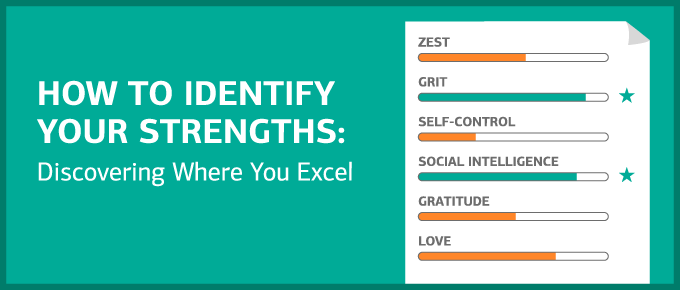
In their book, Character Strengths and Virtues: A Handbook and Classification, psychologists Christopher Peterson and Martin Seligman identify 24 character strengths. This list can provide another angle to identify your virtues. See if you can identify your top 5 character strengths from this list:
- Zest: Approaching life with excitement and energy
- Grit: Completing something despite obstacles; a combination of persistence and resilience
- Self-control: Self-discipline and regulating what one feels and does
- Social intelligence: Awareness of motives and feelings of other people and oneself
- Gratitude: Awareness of and feeling thankful for the good things that happen
- Love: Valuing close relationships with others
- Hope: Expecting the best in the future and working to achieve it
- Humor: Enjoying making other people laugh and smile, not taking life too seriously
- Creativity: Self-expression and discovering new ways to think about and do things
- Curiosity: Taking interest in learning and trying new experiences
- Open-mindedness: Looking at the world from different angles without jumping to conclusions
- Love of learning: Mastering new skills and topics
- Wisdom: Learning from experience and having good judgment
- Bravery: Facing obstacles, despite fears and speaking your truth
- Integrity: Consistently speaking your truth and presenting oneself authentically
- Kindness: To be considerate, helpful, and generous to others
- Citizenship: Working as a team player in a group
- Fairness: Giving others a fair chance
- Leadership: Motivating a group in a way that makes each person feel valued
- Forgiveness: Accepting people’s shortcomings and letting go of blaming others
- Modesty: Allowing victories to speak for themselves without seeking the spotlight
- Prudence/Discretion: Making sound decisions
- Appreciation of beauty: Noticing and appreciating all kinds of beauty
- Spirituality: having beliefs about the higher purpose and meaning of the universe
4. Assess through others

Self-awareness is how we view ourselves, but it also includes an awareness of how we are perceived by others.
We can learn a lot from how other people view us, especially from supportive, trustworthy people like friends, family, coaches, and mentors. They may notice strengths in you that you didn’t realize you had.
Speak to people who know you well to help determine your strengths. Using the list of character strengths as a jumping-off point, talk about how they see you. You may be surprised to learn that a quality you possess is exceptional.
5. Surround yourself with supportive people

Who you surround yourself with can change everything. The circle of people around you impacts your behaviors, thought patterns, and certainly how you view yourself.
Your strengths won’t be expressed or grown unless they are in an inviting environment, around supportive, genuine people that lift you up. That means spending time with people who genuinely want to see you succeed.
Also, that can mean associating with people who inspire you to pursue your strengths, rather than constantly knocking you down with every achievement, or criticizing you for your weaknesses.
6. Work with a coach or mentor

On your path to self-actualization, you’ll need a cheerleader on the sidelines who can help you stay on track, even when your motivation drops. A coach or a mentor can provide the push you need to feel confident in not only identifying your strengths, but putting them into action.
Speak with a coach who can lead by example and give you practical advice toward creating the life that you want to live, in line with your strengths and core values.
Peer networks like mastermind groups can also provide this support.
7. Learn the difference between True Strengths and Pseudo Strengths

Be careful about what I call pseudo strengths. A pseudo strength looks like a strength from the outside to those watching, but feels life-sucking from inside. These are things we can do better than average, but when we finish doing these things, we feel weaker.
Just because you’re good at something, doesn’t mean you enjoy doing it. Sometimes our strengths don’t align with personality traits. For example, you may be great at networking but also an introvert. In that case, spending a lot of time interacting with others will make you feel drained.
So you need to be aware of these conflicts to perform at your best and feel your best. Look at those strengths and understand where they overlap with your passions and personality.
This requires a bit more self-assessment. When you employ your strengths, such as creativity or motivating others in a meeting, how does it make you feel? Do you feel energized and empowered, or do you feel drained and exhausted? In the long term, you will burn out by pushing yourself toward strength areas that conflict with other parts of your personality. So you want to find that sweet spot where your strengths, passions, and personality overlap.
8. Understand what you’re good at vs. what you’re passionate about

We’ve already gone over a few methods to identify your strengths. But what about your passions? What brings you to life and makes you feel full of joy and purpose?
Now we need to connect the dots between your strengths and values. Identifying your passions starts with pinpointing your core values. Core values point the needle of your compass, illuminating the pathway toward living a meaningful life filled with passion and purpose.
Let’s say your strengths lay in creativity (self-expression and discovering new ways of doing things) and bravery (facing fears and expressing truths). What if you also highly value things like community and social equity?
In that case, activities like motivational speaking, writing, and activism would all play well into your strengths, leading to success in pursuing those passions.
When you stick to your core values, your day to day activities will align with what matters to you. You can pursue those activities that bring you to life — your passions!
9. Experiment

Don’t just think about it. Experiment with It.
Taking self-assessment tools and identifying strengths can light the way forward. You can get a better sense of which direction to go in life. But how to find what you’re good at, and what you enjoy, without giving it a try?
Much of learning what you’re really good at and enjoy doing requires some experimenting. That means trying things out, seeing how it goes, and adapting based on experience. Give yourself space to experiment and try new things. Ask yourself:
- What are your strengths?
- What do you enjoy doing?
- Where can I apply strengths and passions?
- What makes you feel valued?
Remember that you don’t need to do something perfectly, or even well. Don’t let perfectionism get in the way. When doing something for the first time, you may make mistakes or even do a lousy job. Approach it with an open mind to simply try something for the sake of learning.
Recognizing weaknesses

A part of self-awareness means seeing the full picture, which includes our strengths as well as the not so flattering parts of ourselves. We must not ignore our weaknesses, but there’s a difference between recognizing weaknesses and being paralyzed by them.
We can address weaknesses by managing against them. Don’t let them trip you up. The majority of our time and effort are better served by focusing on strengths and growing those muscles.
Accepting our weaknesses can empower us. We don’t need to change who we are. Instead, we can cultivate strengths while also maintaining awareness of our weaknesses.
You can also learn to value those around you for their unique strengths. For example, if you run a business or work on a team, you can balance your weaknesses by working with people that have strengths in areas where you lack.
You may have excellent visionary abilities but have trouble in executing the details. That’s when you could benefit by partnering with someone who is detail oriented to create a powerhouse team.
Remember that developing your strengths is a learning process. With time, you can become better at doing something or realize that you just don’t enjoy certain activities like you used to.
That’s okay. Strengths can change and evolve. Continue with self-awareness and you keep learning how to apply your best traits towards building the fulfilling life you desire.
At SoulSalt, we help people find the intersection of their strengths and core values. That is where the magic of purpose and fulfillment happens. When you’ve taken some time to identify your strengths and weaknesses, check out our online resources for discovering your truth and living it.