Intuition provides a powerful tool in building a meaningful life. When you learn how to tap into your intuition, you’ll naturally move towards your vision, make better decisions, and create the life you want.
But what is this mysterious force, and how can we recognize when it’s telling us something important?
Science tells us that we all have several different types of intelligence, although we tend to pay most attention to the rational brain. Listening to intuition is a process of waking up to all the intelligence we have — in our bodies, hearts, and subconscious minds.
This article is all about learning how to tap into your intuition, trust your gut, and start enjoying that feeling of being in the flow of your life.
What is Intuition?
Have you ever had a hunch about something? I’m talking about a gut feeling guiding you in the right direction. In my coaching practice, I’ve heard clients say things like:
“In my heart, I knew I needed to stay and not leave him alone.”
“My gut just couldn’t get over the feeling that this would be a poor hire. Later, we found out our candidate had a criminal background.”
“I knew, without knowing how I knew, that this was the correct next step.”
Your intuition is an inner voice, calling from deep within, guiding you to make decisions and fulfill your purpose. It’s a way of knowing something, without knowing exactly how you know.
“Intuition is the ability to acquire knowledge without recourse to conscious reasoning. Different fields use the word “intuition” in very different ways, including but not limited to: direct access to unconscious knowledge; unconscious cognition; inner sensing; inner insight to unconscious pattern-recognition; and the ability to understand something instinctively, without any need for conscious reasoning.”
Wikipedia
I describe intuition as:
- A gut feeling or hunch
- An innate longing or push in a certain direction (rather than a learned response)
- The process of simply knowing, without explanation, analysis, or logical reasoning
- Feeling “in the flow”
You don’t have to reject logic in order to benefit from intuition. When you combine intellect with intuition, you are simply using all the information available. You are not limited to only your conscious thought processes.
With the logical brain, you can identify your purpose, set long-term goals, and make plans to achieve them. When you also tap into your intuition, it becomes much easier to make decisions in alignment with your purpose, leading you towards those conscious goals.
For many, intuition may seem like a woo-woo concept, but it’s a very real type of intelligence, backed by science.
Trust Your Gut: The Science Behind Intuition

When faced with a problem, people often turn to logic, a scientific approach to reasoning. You gather the facts. You analyze your options. You come up with a solution.
This complex process occurs in the frontal lobe of the brain, often called the “rational brain”. It serves as an excellent tool for problem solving, planning, organization, reasoning, and managing emotions, according to Changes Psychology.
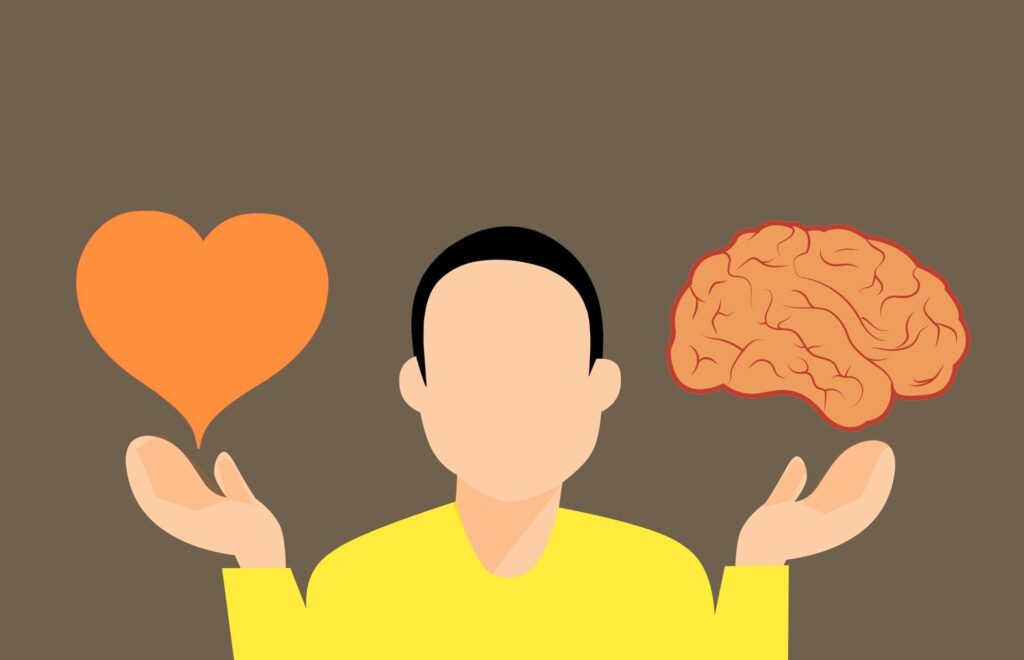
But your head isn’t the only one doing the thinking. Much of the thinking in the body also happens in your heart and in your gut. Through research studies, scientists classify the head, heart, and gut as three functional brains, each containing complex neural networks..
Using the combined wisdom of your “3 brains” can help make smart decisions, avoid dangerous situations, and build stronger relationships.
The Heart Brain
When trying to make an important decision, has anyone ever suggested that you “listen to your heart”?
Your heart constantly sends emotional signals, communicating your needs, fears, and desires, according to a 2019 study from Cerebrum. This is your emotional center of intelligence, and your brain uses those signals from your heart to help process how you feel.
Scientists call this the intrinsic cardiac nervous system, or the heart brain. Humans have as many as 40,000 cardiac neurons, working together from the heart up along the vagus nerve to the brain.
The Gut Brain
If you’ve ever followed a hunch or felt butterflies in your stomach, you’ve already recognized your gut brain.
Your gut brain is hidden inside the walls of your digestive tract. Physicians call this the enteric nervous system (ENS), or “gut brain”. It consists of over 100 million nerves lining your gastrointestinal tract from the esophagus to the rectum.
Your gut sends over 400 times more messages from the gut microbiomes to the brain, than from the brain to the gut, according to a study in The Journal of Medicinal Food.
The gut brain shows you how to tap into your intuition—your gut instinct. Sensations in the stomach or intestines tell you about a situation to better interpret your surroundings or even to sense danger.
In fact, many chronic digestive conditions occur because the gut is signifying stressors. 70% of patients with Crohn’s disease and ulcerative colitis believe that symptoms of their disease are related to stressful events.
In other words, your gut is alerting you of a stressful situation, rather than the brain signaling the gut.
You probably have a sense of this already. You might get an upset tummy before a big event. Perhaps, a person gave you knots in your stomach because they made you feel uncomfortable. That’s your gut instinct.
Researchers have found that listening to your gut instinct helps make better decisions. Stanford psychologists conducted a valuation of head vs. intuition in decision making strategies. The results found that going with your gut led to the best outcomes 68% of the time compared to logic-based decisions.
That’s not to say that the brain is useless, of course. Your brain is one of the most complex organs, composed of billions of neurons that store memories, process your surroundings, and devise solutions to really complex problems.
Listen to your gut. Follow your heart. Use your head. Listening to all three brains is critical in decision making.
In neuroscience, it’s known as multiple brain integration or mBIT. When making an important decision, you can use the combined intelligence of your head, heart, and gut.
In practice, mBIT feels the same as learning how to tap into your intuition. It leads to a higher level of self-awareness that will guide you to make better decisions.
What Following Your Intuition Looks Like

In the age of science, we tend to overemphasize logic. While logic certainly has its place when it comes to critical thinking and problem solving, it’s not the only type of intelligence that you can use.
When you rely solely on logic, it’s like only using one tool from a toolbox. But you wouldn’t want to use a saw to screw in a nail. Intuition, gut instinct, emotional and physical sensations—you have other types of intelligence beyond your intellect at your disposal. Why not use them?
We need to marry our intuition with our analytical and reasoning mind in order to “get” what it is saying and to interpret the meaning for application purposes. Combining instinct and reason is necessary to make the best possible decisions.
However, even when we experience meaningful success by following instincts, we are inclined to distrust it. Our cultural tendencies are to trust things we can know for sure and measure.
In our educational systems, we focus on facts and testing. We neglect emotional intelligence, body awareness, and creativity, which are all part of learning how to tap into your intuition.
It’s time to restore balance.
The intuitive mind is a sacred gift, and the reflective/rational mind is a faithful servant. We have created a society that honors the servant and has forgotten the gift.
Albert Einstein
We need to access the combined wisdom of the head brain, the emotions of the heart brain, and the instincts of the gut brain. When you take the three into consideration, you’ll have a fuller perspective on achieving a successful life in alignment with your core values.
5 Ways to Tap Into Your Intuition

Intuition is a powerful, instinctive intelligence that we all have. But because it occurs subconsciously, it takes more sensitivity and subtle approaches to hear what it has to say.
Developing intuition is a skill that you can get better at with the right techniques. Here are five strategies to practice using all your ways of knowing, effectively tapping into your intuition in all areas of life.
1. Quiet the Mind
Following your intuition requires a new way of listening. For people who rely on logic, thoughts usually take the steering wheel for decision making. When you want to shift gears and trust your gut, you’ll need to get out of your head and listen to your body.
Sometimes, you need to sit in the stillness and quiet to understand what your intuition is telling you. Quitting your mind allows your awareness to expand, including your physical and emotional state. You’ll also become more aware of your surroundings.
You can do this with regular mindfulness practices, like walking, yoga, or mindfulness meditation, that quiet down the chatter of your thinking brain. Over time, you’ll learn to drop into a state of relaxation and calm awareness.
In your day-to-day life, you can practice quieting the mind by noticing your surroundings and sensations. Notice the color of the sky. Feel the temperature of the air. Notice how you experience sitting in front of a warm mug of tea. Recognize how you feel around certain other people.
Bring awareness to the thoughts that arise and the feelings in the body, and do so without judgment. Over time, your conscious awareness will begin to spot nagging thoughts, gut feelings, and hunches as intuition trying to get your attention.
2. Notice Physical Sensations
When you follow your intuition, you feel in the flow. You’ll know it when something is right. It will feel clear, nourishing, and empowering.
The moment you fall off track (which happens to everyone from time to time), you can feel that, too. It feels like you’ve lost your way, nothing goes right, and you can’t see how to get back on track.
But what does that feel like in your body?
When faced with a choice, even a small day-to-day decision, notice how your body reacts. You may feel knots in your stomach. Your heart may start to race. You may experience tightness in your chest. Something just feels off.
You’ll know your intuition is there because you’ll be able to feel it – if you let yourself. You’ll feel it in your belly, goosebumps on your skin, a shiver down your spine, your heart begins to race, or a quickening of your breath.
Sometimes it’s even more subtle, and the only way to describe it is a “feeling in the bones” or a “knowing”.
These sensations are actually an innate function of a healthy human autonomic nervous system. It’s the body’s way of communicating through you.
Pay attention to these physiological responses. Investigate them. Use them as sources of information, clues to what your intuition might be telling you.
3. Learn to Differentiate Fear and Intuition
Just because something feels unpleasant, in your gut or your chest, doesn’t mean you should avoid it.
Fear often arises when addressing vulnerabilities. Your heart beats faster when you go in for a big interview. You get butterflies in your tummy before a first date.
Many of us develop fears without even realizing it at a young age. Perhaps a traumatic moment in your childhood made you feel like you couldn’t be yourself. You carry this fear throughout your life, without noticing that it prevents you from being authentic and connecting with people.
Another common fear is failure. Many people have a strong physical reaction in the face of big opportunities or exciting challenges. Subconsciously, they are afraid of what it will mean if they don’t succeed or do it perfectly. This can show up as perfectionism or chronic procrastination.
When you feel nervous or afraid, use your rational brain to observe and investigate your physical sensations. Explore what they feel like, what they may be trying to tell you.
When you understand the messages from your nervous system, you can use this knowledge to make better decisions. Maybe you just need to take baby steps to heal and overcome your fears.
4. Nurture Other Ways of Knowing
We all have our unique pattern of receiving intuitive hunches. You can experience intuitive messages through a number of ways. When you accept that this intuition thing is real, you’ll begin to understand what to do with it.
Some folks see things. By this, I mean they see with a mind’s eye as an image or a scene play out. Maybe they actually see a projection of an image or movie in front of their third eye chakra. This is often called clairvoyance.
Some folks hear things, either literally or within their mind. We often call this clairaudience.
Others just know something without an explanation, as if the subconscious dictates a “fact” to the consciousness. This is called clairsentience.
These experiences can be written off as daydreams, deja-vu, or just pure imagination. However, if you want to tap into your intuition, you have to accept and nurture all the ways your subconscious mind expresses itself.
Practice by being more observant of your thoughts, even the strange and unexplainable ones. Keep a notebook with you (or use an app) to record ideas, visions, or sounds that pop into your head throughout the day. Artists and writers do this to harness creative ideas, but it’s also a great way to strengthen your intuition.
5. Learn When to Walk Away
In her book, Big Magic, Elizabeth Gilbert writes about her experience with intuition. She had this epiphany that she needed to write about her friend’s experience in Brazil during the 1960s.
From a logical standpoint, she knew nothing about the subject. But something deep down pushed her to pursue this project. Fast forward—Gilbert successfully sold her idea for a novel “Evelyn of the Amazon” to publishers.
While Elizabeth had her plans, life had others. Personal events put off the completion of her book for several years. When she returned to complete the project, she realized, “The living heart of my novel was gone. The sentient force that inhabits all vibrant creative endeavors had vanished.”
In the meantime, another writer had simultaneously and independently been inspired to write a novel — with the same setting and eerily similar plot. The Big Magic here is that Gilbert let an idea fly away, and it landed with a writer who had the time and energy to bring it to life.
Tapping into your intuition is another way of tapping into your creativity. The first step is noticing when an idea, a sign from the universe, or a dream is knocking on your door. The next step is deciding whether to listen. If it doesn’t work out, or something else calls you away, it’s ok to let it go.
Practice an abundance mindset. Know that there is not a finite number of ideas or opportunities. As you learn to trust your intuition, you will find another path leading towards your goal, or discover a new, more interesting goal.
Keep your eyes open. Listen. Follow your curiosity. Ask questions. Sniff around. Remain open. Trust in the miraculous truth that new and marvelous ideas are looking for human collaborators every single day.
Big Magic, by Elizabeth Gilbert
The path of life isn’t always straightforward. You may trust your gut, go down one direction, and hit a dead end. Don’t beat yourself up. After all, life is about discovery and experience. You never know the next adventure just around the bend.
Your instinct isn’t wrong. Trust the guiding voice of your intuition. Even when a door closes, it will lead you to new avenues that you could never have imagined.
6. Use Both Intuitive and Reflective Thinking
When intuition and logic agree, you are always right.
Blaise Pascal
In his book, Thinking, Fast and Slow, Nobel prize winner and renowned psychologist Daniel Kahneman describes two ways of thinking: intuitive and reflective.
Intuitive Thinking: Fast, instinctive, and emotional, intuitive thinking is an unconscious process best suited for rapid action judgment and decisions. It helps you understand reality quickly, without logic or analysis.
Reflective Thinking: Slow, deliberate, and logical thinking best when applied to complex problems. This helps you look at the bigger picture, to understand why you did what you did, and why that matters.
Sometimes intuition calls on logic for support. You can turn to logic when your intuition doesn’t have the answer. Logic supports intuitive thinking in more detailed, specified processes to solve problems.
Reflective thinking helps you learn from mistakes. You can recall a time when you said the wrong thing or overreacted in the heat of the moment. Logic can help correct the situation and avoid repeating that behavior.
7. Look for Patterns
If life is a highway, then your intuition is the traffic signs along the way saying, “Stop”, “Yield”, “Caution”. Your intuition guides you along the road of life, points out potential dangers, and tells you which direction to take next.
Learning how to tap into your intuition is a process of becoming more aware of the signs and patterns.
As a practical exercise, watch for patterns while driving. Notice who is ahead of you, who is behind, and the flow of traffic. Remain observant for anything that breaks the pattern by going too fast, too slow, or weaving instead of forward motion.
Use intuition in the same way when crossing a street. Use what your eyes see, what your experiences tell you, and what your instincts say to cross at a completely safe and sane time.
This honors all of your ways of knowing and sharpens them for the next time your intuitive tools want to send you a message.
If this sounds a little abstract, let me provide a few practical examples:
- Have you ever received a job offer or promotion that just didn’t feel right, even with a great salary and benefits?
- Did you ever become physically ill, after working too many long hours?
- Maybe you needed to end a relationship, even though you had a lot of love and respect for that person.
These are all instances of your intuition speaking to you, picking up on patterns, and guiding you where to go. Listening to your intuition helps you avoid repeating harmful patterns, and can help you build more successful ones, too.
Coasting through life unaware, you will miss the signs. By being on the lookout for patterns, you’ll see when something breaks the norm. This will lead to more of those intuitive hunches you get around hidden opportunities and dangers alike.
Tap Into Your Intuition for a Truly Aligned Life
Tapping into your intuition will bring you towards your goals faster, whether it’s starting a new career, a passion project, or a personal reinvention. When you start paying attention to all the ways of knowing, you will experience life in true alignment — head, heart, and body.
If you’re having trouble following your intuition, and need guidance, give us a shout.
We’re in the business of turning dreams into reality. We’d be honored to support you!

