Does it sometimes feel like you have no idea how to control your emotions?
This is completely normal and it happens to everyone.
After all, who hasn’t said something they instantly regret in the heat of an argument, or said no to an exciting opportunity out of fear?
But here’s a secret – you don’t have to live your life subjugated to your emotions. It’s entirely possible to learn how to get your emotions under control and reap all the benefits when you do.
Just like controlling your thoughts, learning how to control your emotions helps you avoid impulsive actions that can derail your success.
Studies even show a strong correlation between healthy emotional regulation, success, happiness, and wealth.
Controlling your emotions frees your mind to make daily decisions that align with your values and beliefs.
If this sounds like something worth pursuing, then keep reading. Below I explain how to identify your and control your emotions to support well-being and intentional action toward your goals.
Mastering Your Emotions: 13 Healthy Ways to Deal With Them:
- Don’t React – Respond
- Rid Yourself of Excess Cortisol
- Self-Regulate With the 5-4-3-2-1 Method
- Establish a Daily Routine
- Go for a Mindful Walk
- Focus on the Positives
- Take a Time Out and Breathe
- Monitor Your Mood
- Practice Gratitude
- Develop a Support System
- Engage in Creative Activities
- Set Boundaries
- Seek Out Professional Help
Originally published on 31 August 2022, this article was republished on 17 May 2024.
Identifying Emotions and What to Do With Your Feelings
As humans, it’s only natural to feel emotions – they play a key factor in a person’s overall well-being.
Emotions put color to our life experiences
Emotions guide you toward a life that brings you joy, make you laugh, feel happy, and shine from within. Even unpleasant emotions, like fear or sadness, have a purpose. They can protect you from danger or from making decisions that don’t align with your core values.
However, it’s not always easy to identify your feelings, much less understand the role they play in your actions.
And that’s the first step – identification. As soon as you identify how you feel, you can begin to know how to control your emotions.
Here are a few steps to help you identify what you’re feeling at any given time:
- Allow yourself to pause and center yourself in the present.
- Acknowledge any feelings that arise within your body and sit with them for a few moments.
- Think about the emotion you are experiencing and label it.
- Ask yourself, how did this emotion arise? What was the trigger?
As you label your feelings, don’t stop at the basics like sad, happy, or angry. Those emotions are big umbrellas, and underneath, you will find more nuanced feelings.
The Feelings Wheel is a great visual tool to help you find the specific flavor of your emotions. You can follow the branches from your initial emotion to define and label what you’re feeling.
For example, sadness might be loneliness, disappointment, or simply empathizing with others who are in pain. Anger might be jealous, annoyed, or furious!
When you give an emotion a specific name, you have more information about what triggered it and how to manage it in a healthy way.
Only once you know what you are feeling, can you start to learn how to control your emotions.
How to Turn Off Emotions (And What to Do Instead)
While turning off your emotions – especially the uncomfortable ones – completely might sound appealing, this isn’t always the best idea.
According to psychologists, chronically avoiding emotions creates a lot of physiological stress on the body. It can cause mental illnesses like depression and anxiety, as well as physical issues, including insomnia and heart disease.
Embrace your emotions!
Instead of circumventing what is making you feel bad, the solution instead is to acknowledge your emotions and allow yourself to feel them.
Then you can begin to regulate your emotions and dial back the intensity of whatever you may be feeling.
This means finding a balance between feeling intense emotions and feeling none at all.
The experience of life occurs across an entire spectrum of emotions. Blocking out negative emotions might seem appealing, but it can prevent you from experiencing significant portions of your life.
By embracing the negative and positive, you learn how to take control of your life and live with purpose.
Managing Emotions: 9 Healthy Ways to Deal With Them
Some people may feel emotion more intensely than others – that’s totally okay!
There is nothing wrong with feeling deeply.
However, learning how to control your emotions and respond to them with intention is critical for a person’s well-being.
One of the most powerful tools that we can use to help us do that is emotional regulation.
Emotional sobriety involves controlling emotions and impulses. It’s the ability to manage strong emotions by processing them consciously and intentionally.
Let’s take a look at a number of ways that you can do that.
1. Don’t React – Respond
We’ve all had those moments when you feel overwhelmed with emotion.
Those who act out without thinking may say something they may regret later.
So, what can you do when you have a huge emotion? Learn to respond, rather than react.
Reaction vs Response
Reacting: Acting impulsively based on your emotions without thought or intention.
Responding: Processing how you think or feel before responding before reacting to a situation or emotion.
When you respond to your emotion, you take a second to acknowledge what you are feeling. As you experience emotion rising in the body, pause. Learn to consciously respond, rather than abruptly react.
This simple act gives you a chance to better express yourself and communicate how you are feeling.
We can better align with our values when we understand how to self-regulate. We can meet challenges when they face us, view obstacles as opportunities, persist through difficulties, and take charge of our lives.
By taking time to think about what you will say before you say it, based on how you are feeling in that moment, you can help others better understand you.
2. Rid Yourself of Excess Cortisol
Distrust, fear, and anger are all emotions we face daily or weekly – they’re a natural response to our internal and external environment.
Studies show that when we feel these emotions, we produce the stress hormone cortisol.
As your body perceives stress, your adrenal glands release cortisol into your bloodstream. This can make you agitated, irritated and anxious.
During an emotional, stressful situation, it can take up to 26 hours before cortisol no longer courses through our brains and scrambles your thoughts.
The good news: You don’t have to wait 26 hours to rid yourself of excess cortisol – all it takes is one 20-minute break to break the stress cycle.
Try going on a walk, meditating, or switching up the task you are doing to distract you. This will help refresh your system, so your emotions feel less intense and you can think clearly.
3. Self-Regulate With the 5-4-3-2-1 Method
How can I self-regulate, you ask?
This mindful method has your back even when faced with huge negative emotions like fear, panic, and anxiety.
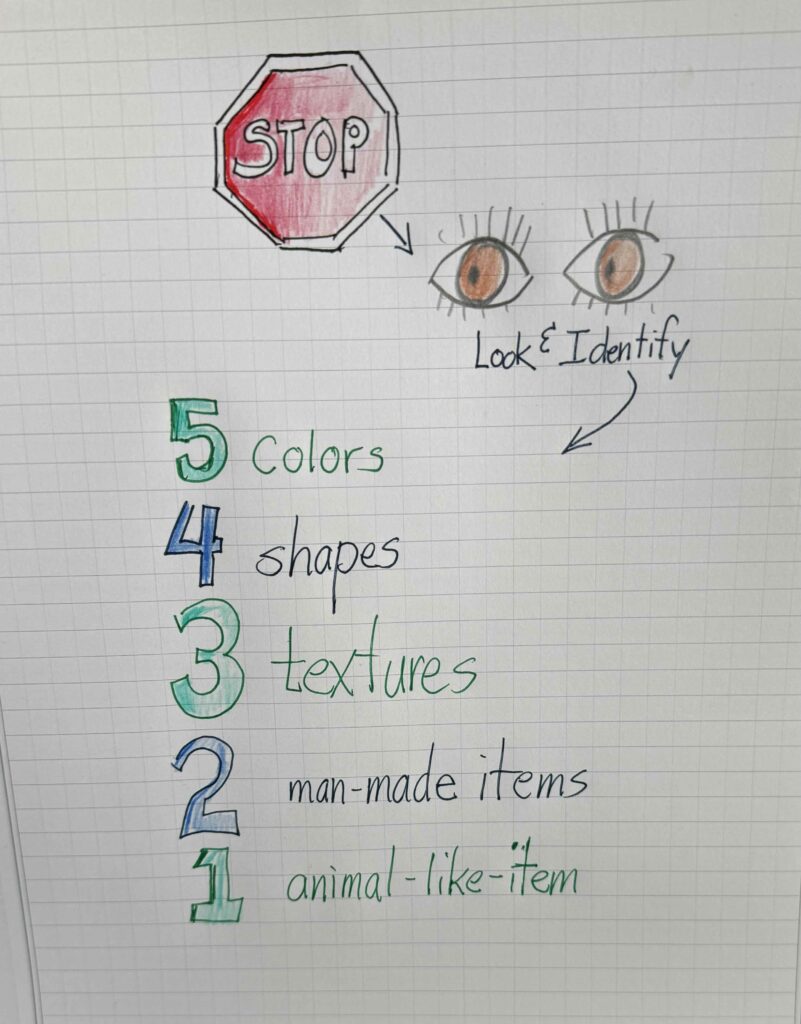
I call it the 5-4-3-2-1 game, and it goes like this:

STOP. Look around and identify:
- Five different colors
- Four different shapes
- Three different textures
- Two things made by humans
- One representation of an animal or an actual animal
Then STOP, breathe and take a break.
By doing so, you reset your emotions back to baseline, ground yourself in the present, and gain a deeper understanding of how to control your emotions.
Here’s a quick visual doodle I put together for you:
It’s as simple as that!
4. Establish a Daily Routine
Never underestimate the power of habits. Establishing a daily routine can make a huge difference when it comes to managing your emotions
Routines allow us to center ourselves after an emotional upset or mitigate against one that has yet to come.
You can create a morning and an evening ritual that you follow each day as you rise and before resting that is guaranteed to shift your mood. These routines are so powerful that some of the most successful people rely on them.
Begin by listing some emotions you wish to feel each day, such as gratitude, happiness, and peace. Afterward, write down an action you can take to make you feel this emotion.
For example, let’s say you want to feel grateful in the morning.
As you wake, write down three things that you are thankful for; this gratitude exercise immediately floods your mind with feelings of gratitude and thankfulness.
Or maybe you’d like to feel at peace before you sleep each night? Enjoy a few moments of silence before turning in to reflect on your day.
By understanding how you want to feel each day, you’ll have more control over taking action towards fulfilling these emotions and, in turn, taking control of your emotions.
5. Go for a Mindful Walk
Mindfulness and meditation invite you into the present moment, where true peace resides.
When you think of meditation, you may imagine sitting in a quiet space with your legs crossed and your eyes closed. While this is a form of meditation that has excellent benefits for the mind, body, and soul, there are other ways to meditate.
Walking meditation?
Deepak Chopra explains that the practice of walking meditation helps us gain greater control over our thoughts, feelings, and actions, enabling us to respond mindfully when negative emotions arise.
As opposed to other forms of mindfulness and meditation, mindful walking meditation focuses on free breathing. What better feeling than stepping outside into nature and embracing all the beauty that life has to offer?
Some people may find it challenging to sit still for long periods, or even a few moments, which is why mindful walking is such a great tool.
It allows you to clear your head and align your thoughts with your body as you step one foot in front of the other. As your mind settles, you can take control of your emotions with clarity.
6. Focus on the Positives
How often do you catch yourself thinking negatively about someone or something and suddenly you feel frustrated or sad?
It happens to the best of us. But here’s a great little secret – it’s something you can control.
Next time you catch yourself thinking a negative thought, try to replace it with something positive.
For example, let’s say it’s your only day off work this week and you had planned to go to the beach with some friends.
Just as you leave the door, the heavens suddenly open. Of course, it’s normal to feel frustrated. But take this opportunity to search for a positive.
For example – instead of focusing on the rain, try to feel gratitude for having a day off and the amazing friends around you.
7. Take a Time Out and Breathe
“My emotions got the better of me”
This phrase is often used by individuals in certain situations. Sometimes when emotions run high we can lose control of our behavior and words.
Taking a moment to step back, breathe and focus on what you can control can do wonders in any given situation.
As you give yourself some space, you can reset and choose to respond rather than react.
If you are in a situation that creates intense emotions, take a timeout and focus on breathing – deep inhales followed by deeper exhales.
In fact, just two minutes of deep breathing with longer exhalation engages the vagus nerve which can improve decision-making and increase heart rate variability.
8. Monitor Your Mood
Start gaining control of your emotions by checking in on your mood.
You can do this by getting yourself a journal and keeping track of your moods.
Simply writing what you are feeling daily and what may have triggered them can help get your emotions under control.
Be honest, be raw, and be specific.
Rather than simply writing, “I’m upset”, search for the deeper meaning of why you’re feeling upset.
What caused this emotion? What was the trigger that brought on this wave of sadness?
By diving deeper, it becomes easier to label your emotions with more nuance, which in turn equips you with better tools for controlling them.
Keeping a mood journal allows you to look back on how you’ve been feeling over time and what triggers to look out for.
9. Practice Gratitude
Gratitude isn’t just a few trite words said in passing – it’s a powerful tool for emotional transformation.
By focusing on the things we’re thankful for, we shift our attention away from negative emotions that might cloud our judgment and towards positivity.
Practicing gratitude doesn’t have to be a grand, complicated ceremony either – you can do it every day with this easy gratitude exercise:
Three Things You’re Grateful For
Simply start each day by listing three things you’re grateful for. Ideally, you should write these down to give them more impact and permanence, but even saying them out loud to yourself can dramatically shift your perspective, making challenges seem more manageable and joys more profound.
Remember, gratitude is like a muscle – the more you use it, the stronger it becomes. So, make gratitude a daily habit and watch as it opens your heart and clears your mind.
10. Develop a Support System
Understanding your emotions can be daunting if you’re attempting to do it on your own – that’s why developing a support system is crucial.
This can mean surrounding yourself with friends, family, or even a community who understand you, support you, and can offer a shoulder or an ear when you need it.
Having a support system isn’t about finding people who will fix your problems but those who will stand by you as you face them. They’re there to listen when things get hard and provide motivation when you need an extra push to get things done.
Whether it’s a comforting conversation, a shared laugh, or just knowing someone is there, a strong support system is invaluable for giving yourself space to figure out your emotions.
11. Engage in Creative Activities
Creativity is not just an outlet for artists – it’s a gateway to emotional clarity for everyone!
Gateway to Emotional Clarity
Even if you don’t consider yourself a “creative person”, engaging in creative activities like painting, writing, dancing, or even cooking can serve as a powerful medium for expressing and processing emotions.
They allow us to channel our feelings into something tangible and provide a sense of relief and accomplishment.
So, next time you’re feeling overwhelmed, pick up a paintbrush or pen or put on your favorite song and dance!
Let creativity provide you with catharsis, and transform your feelings into expressions of art.
12. Set Boundaries
Setting boundaries is like drawing a map of where you end and others begin. It’s an invaluable tool for maintaining emotional health and preventing burnout, and also for separating yourself from people who would drain your time and energy.
By establishing clear boundaries, you communicate to others what you are and aren’t comfortable with.
This isn’t about building walls but rather defining your space, needs, and limits. Boundaries can be about your time, emotional energy, or even your physical space.
When you’re clear about your boundaries, you respect yourself and teach others to do the same, leading to healthier relationships and a more balanced emotional life.
13. Seek Out Professional Help
While self-regulation is a powerful tool, it might not be effective for everyone. If that’s the case, then seeking professional help is always a wise decision.
Why seek guidance?
Therapy or coaching offers a valuable way to improve self-awareness, look deep into undiscovered corners of your mind and soul, and help you identify blind spots in your emotional regulation.
It allows you to express your emotions in a safe space and receive invaluable, unbiased, and impartial advice about what you’re feeling and why you’re feeling it.
Suppressing your feelings will never end well – they’ve got to come out somehow, whether through voluntary discussion or a high-pressure emotional explosion.
The better option is to open up in a safe space where you can be vulnerable without judgment.
By opening yourself up to radical self-reflection, you can start to transform self-doubt into self-belief, and use that to gain a firm grasp on your emotions.
We can help you jumpstart that process with online resources that encourage and enable you to nurture methods of healthy emotional regulation.
Check out our course today and take control of your life.

